
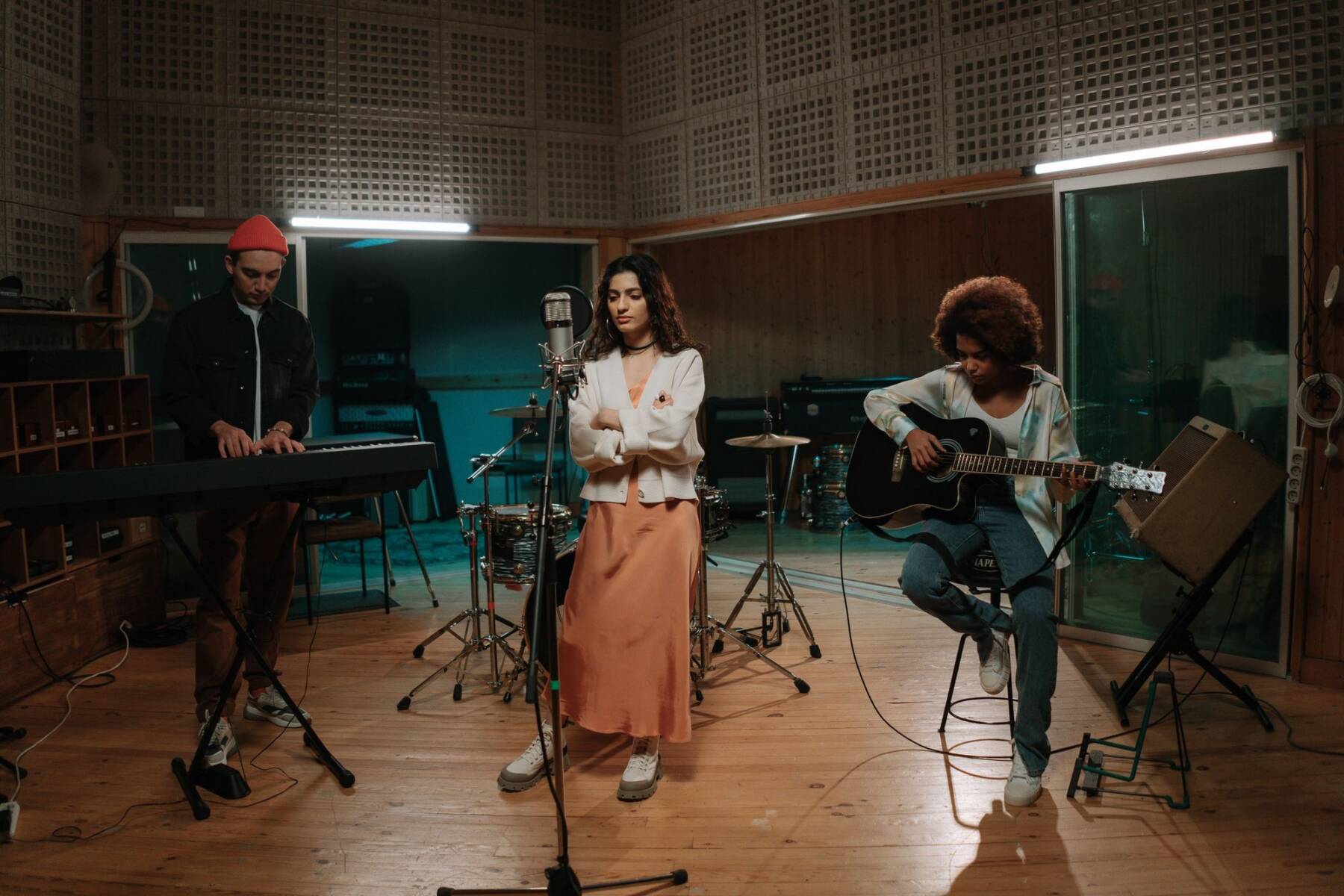
You get together one afternoon, a chorus comes out, someone jots down a lyric on their phone and suddenly there is a song. Then comes the question almost nobody asks at that moment: whose is it?
If you created it together and the result is a single song, it belongs to everyone who contributed that creation. In Spain this is called co-authorship or, in the law, a work in collaboration. The hard part is making it clear in time, before releasing or registering it. This is general information and does not replace professional advice on your situation.
What the law says when you write together
The intellectual property in a song belongs to the author by the mere fact of creating it. No process is needed for the song to be yours. The law protects musical compositions, with or without lyrics, and considers the person who creates them to be the author.
When that song is the unified result of the collaboration of several authors, the rights belong to all of them. This is what Article 7 of the Spanish Intellectual Property Law calls a work in collaboration.
The consent of all the co-authors is needed to release or modify it. If there is no agreement, a judge decides. Once it has been released, no co-author can unjustifiably refuse consent to keep exploiting it in the form in which it was released.
The rights belong to everyone in the proportion that you determine. If you haven’t set it out, the Civil Code presumes that the shares are equal, unless the contrary is proven.
Not everyone who takes part is a co-author
The author is the person who creates the music or the lyrics. Whoever sings, plays or records has their own rights as a performing artist. Whoever takes the initiative and the responsibility for the first recording is the producer of the phonogram, also with their own rights. You can be all three at once, but it is not automatic.
A “feat.” in the title or an afternoon in the studio does not by itself make you a co-author. What counts is whether you contributed something original to the composition: a melody, a harmony, a lyric, a hook. If someone only advises, mixes or performs what has already been composed, that does not make them a co-author. We look at this in more detail in our guide to types of collaborations between musicians.
Creating together is also not the same as using something that already existed. The collective work of Article 8 arises on the initiative and under the coordination of a person who edits it and releases it under their own name: unless otherwise agreed, the rights belong to that person.
The composite work of Article 9 is a new work that incorporates a pre-existing work without the collaboration of its author. Their authorization is required. For example, if you write lyrics for a melody that already exists and its author has not worked with you, or if you use someone else’s finished instrumental.
How the co-authorship of a song is split
The law lets you decide the proportion. The usual way is to think of it in two layers: the music and the lyrics and, within each, who contributed what. If one person writes the music and another writes the lyrics, a common split is 50% for each part. If there are two of you on the music, that half is divided between the two, unless you agree otherwise.
The most practical thing is to put it in writing in a split sheet, and in Shamusic you do it when you register the song: you enter the title, the authors, each person’s contribution and percentage, and it is saved with the date and time. That split is the reference for everything that comes next: SGAE, distribution and metadata.
Then, when you register the song with SGAE, you state the same authors and percentages. If there is no agreement, the organization’s Regulations split a composition with lyrics 50% for the musical part and 50% for the literary part, and the co-authors of each part equally. You can agree on a different split, as long as it respects the organization’s rules. SGAE manages and collects those rights, but you have the agreement and the proof of who wrote what in Shamusic from the start.
An example of a split
Luis writes most of the music, Ana writes the lyrics and Marta contributes the melody of the chorus. A possible split, agreed and signed, could be this:
-
Luis, music: 40%
-
Ana, lyrics: 40%
-
Marta, chorus melody: 20%
It is not the only correct split. The correct one is the one you truly agree on. If no agreement is reached, the law presumes equal shares.
What to agree on before and after writing
Before you sit down to write
You don’t need to slow down inspiration with a contract. It is worth talking, even in a message, about four things:
-
Who is going to write what: music, lyrics or both.
-
That the song, if it goes ahead, will belong to everyone who contributes creatively, and that the percentages will be settled in writing.
-
That nobody will release it, send it to a label or register it alone without the consent of the rest.
-
What name each person will appear under in the credits.
When the song already exists
As soon as you have a version you recognize as the song, do this:
-
Settle the split in the Shamusic split sheet. The total has to add up to 100%.
-
Register the song with Shamusic under the name of all the co-authors, not just one.
-
Use those same names and percentages at SGAE, with the distributor and in the metadata.
-
Keep demos, projects, lyrics and the messages in which you sent the song to each other, with their dates, without rewriting the original files.
-
Don’t release it until everyone has given consent to release it.
If a publisher or a label comes in later, review which rights are assigned and which you keep. That contract should not contradict the split agreed between the authors.
How to leave proof of who wrote what and when
Your rights exist from the moment you create the song. The problem, if there is a disagreement or if someone uses the song, is being able to prove it: who created it, what each person contributed and since when it existed. If you come across a copy, our guide on what to do if someone has copied a song can help.
The law presumes as the author, unless proven otherwise, the person who appears as such on the song with their name, their signature or a sign that identifies them. That is why your name, or your artist name, should appear on lyrics, scores, credits and files. Dated evidence also helps: voice notes, demos, recording projects, lyric drafts, emails and messages, and the signed split agreement.
The simplest way to solve it is to register the song with Shamusic as soon as you finish it. You upload the file, say who the authors are, each one’s role and percentage, and you get a certificate with the exact date and time and a verification link that anyone can open. That leaves a record of who wrote what and since when the song existed, before you show it to anyone.
With the collaboration feature you tie everything up from the start: you agree on the terms, mark the song as co-authored and include each author with their share. You all have the same proof and the same split, without depending on a message lost in a chat.
You start with 3 free songs when you create your profile. You can check the current rates on the pricing page. The plan with unlimited registrations and unlimited collaboration agreements is there too.
Share your music, protect it first
Writing with someone is one of the best ways to make songs. It is also one of the easiest ways to get tangled up if you leave everything at a “we’ll talk about it later”.
Talk about it early, put the split in writing, register the song with Shamusic under everyone’s name and keep proof of who did what and when. That way the song will keep belonging to those who created it.
Register your song at open.shamusic.es and enter the co-authorship and each person’s percentage.
Share your music, protect it first.