
Shamusic’s new Certificate of Registration: the proof of authorship that protects your music internationally.
In today’s music industry, where uploading music online is becoming easier but protecting it properly remains a challenge, copyright registration is a strategic first step for any emerging artist.
Shamusic presents its new Certificate of Work Registration, a professional, clear and verifiable document that accredits the authorship of a song through blockchain technology, offering a solid, international and unalterable proof against plagiarism.
This certificate is not just an attractive design: it is a legal and strategic tool designed to protect music against plagiarism and professionalize the career of independent artists from minute one.
What is the new Shamusic Certificate?
The Shamusic Registration Certificate is a document with international legal validity generated after uploading a work (lyrics, beat, melody, demo or finished song) to the platform.
When registering it in the platform, the system generates:
-
A unique digital fingerprint of the file (hash).
-
A blockchain registry.
-
An identifiable Smart Contract.
-
A verifiable public transaction.
-
A downloadable certificate with all key data.
When you upload your work, the system generates a unique mathematical representation of the content: the hash. That fingerprint is unrepeatable. If you change a single note or word, it changes completely. That hash is the one that is registered in blockchain, leaving a record that this work existed on a specific date.
Detailed analysis of the certificate
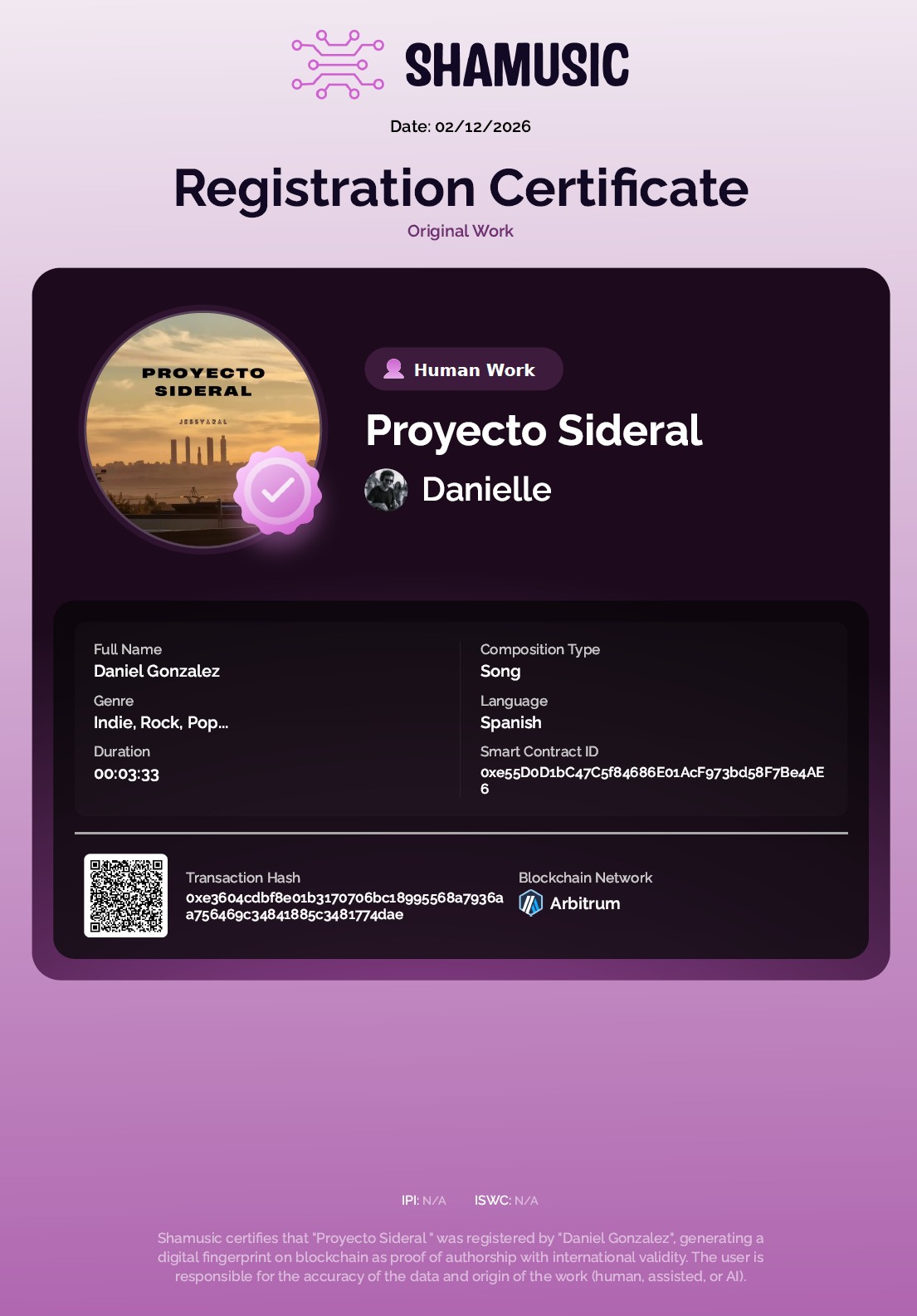
Identification of the work
At the top of the certificate we find the essential elements:
Title of the work
Example: Sideral Project
It must exactly match the title that will later be used for:
-
Upload single to Spotify
-
Register song in SGAE
-
Distribute on streaming platforms
-
Signing musical collaboration agreements
Documentary consistency avoids future conflicts in the management of music rights.
Type of work: “Human Work”.
The certificate specifies whether the work is:
-
Human creation
-
AI-assisted
-
Generated with technological support
This provides legal transparency in a context where artificial intelligence is an increasing part of the creative process.
2. Technical data and professional authorship
The core block of the certificate includes:
-
Author’s full name (legal name).
-
Stage name.
-
Music genre.
-
Exact duration.
-
Type of composition.
-
Language.
The legal name is the one that has legal validity. The artistic name is the commercial identity. Separating them is an indispensable professional practice.
Two key identifiers in the international music industry may also appear here:
IPI (Interested Party Information)
The IPI is the international number that identifies an author or composer within collecting societies such as SGAE. It is like the professional ID of the creator in the global copyright system. It is a number that only collective management entities such as SGAE give you.
Including the IPI on the certificate provides an additional layer of professionalization, as it links the work not only to a personal identity, but also to its registration within the international rights management system.
ISWC (International Standard Musical Work Code)
The ISWC is the international code that identifies a specific musical work worldwide. It does not identify recordings (that is done by the ISRC), but the composition itself.
If the work already has ISWC, including it in the certificate connects the blockchain record with the global music identification system used by publishers and collecting societies. This is especially addressed in Shamusic to all those who already have works uploaded or shared with the public and want to register them.
The combination of legal name, IPI and ISWC creates full traceability: identified author + identified work + technological proof of prior art.
Smart Contract ID: the structure that executes the registry.
The Smart Contract ID is the smart contract identifier that manages the registration in the blockchain network (Arbitrum).
It is the system that:
-
Receives the hash of the file.
-
It associates it with an exact date and time.
-
Execute the transaction on blockchain.
-
It leaves it publicly and immutably registered.
It cannot be modified or deleted. It is internationally verifiable.
4. Transaction Hash and Blockchain Network (Arbitrum)
Transaction Hash
The Transaction Hash is the unique identifier of the transaction that was recorded on the blockchain.
It does not represent the song, but the official act of having recorded it.
It allows to demonstrate:
-
When the work was registered.
-
That the transaction exists.
-
That it has not been altered.
In case of dispute, the process would be:
-
The transaction is accessed using the Transaction Hash.
-
The exact date is checked on the network.
-
The hash of the original file is regenerated.
-
It is compared to the hash stored in blockchain.
If they match exactly, it proves that the specific content already existed on the date recorded. This mathematical coincidence is the proof of anteriority.
Blockchain Network: Arbitrum
For the artist what is relevant is that:
-
It is an international network.
-
It is decentralized.
-
Guarantees immutability.
-
Provides public traceability.
This makes registration much more robust than sending an email or saving the file to a computer.
5. Verifiable QR code
The certificate includes a QR code that connects directly to the transaction on blockchain.
By scanning it you can:
-
Access the public transaction.
-
Confirm the date.
-
Verify that it is still intact.
-
Check the authenticity of the record.
The QR transforms the certificate into a dynamic tool for immediate verification. In front of a seal, a manager or a potential collaborator, it allows to demonstrate professionalism in seconds. And in the face of possible plagiarism, it acts as a deterrent: there is a public, verifiable and unalterable time stamp.
Distribution of rights and royalties
The certificate not only protects the work, but also documents ownership and economic distribution.
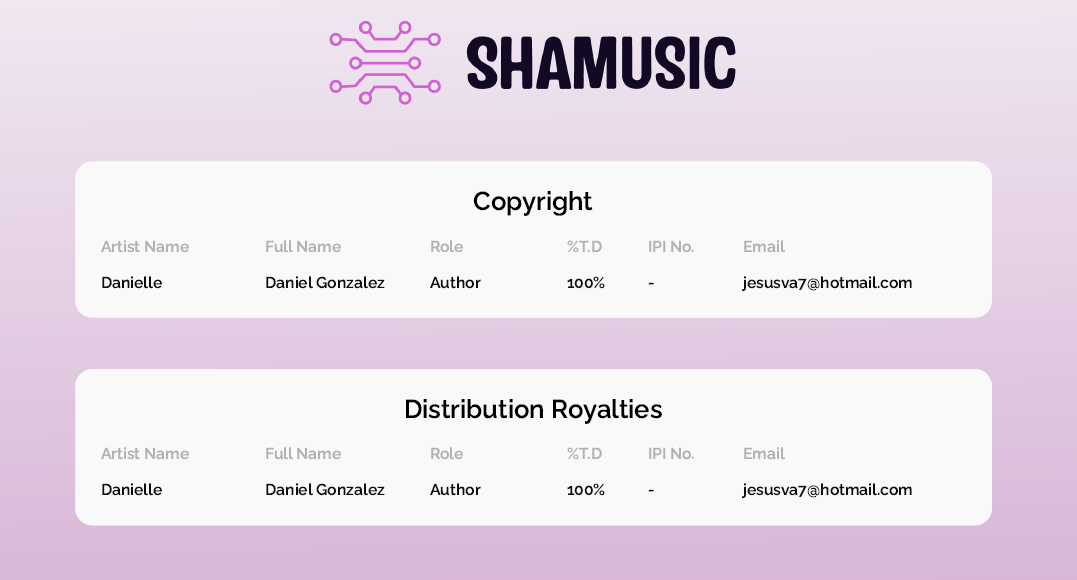
Copyright
These are those rights or royalties distributed by collective management entities such as the SGAE in Spain. It includes:
-
Stage name.
-
Legal name.
-
Role (author, composer, etc.).
-
Percentage of rights (%).
-
IPI (if any).
-
Contact email.
This is essential to avoid future conflicts in royalty management.
Distribution Royalties
This specifies how the benefits derived from the work will be distributed.
It is especially important when:
-
Musical collaboration agreements are signed.
-
We work with producers.
-
Authorship is shared.
-
It is distributed internationally.
Documenting these percentages before uploading music to streaming platforms avoids disputes when revenues begin to be generated and then shared by distributors.
Strategic Difference: Shamusic vs SGAE Registry
Shamusic protects authorship right from the start by registering song copyright with blockchain proof and verifiable timestamp.
SGAE manages the collection of public communication rights.
The recommended strategic order is:
-
Register the work in Shamusic.
-
Register with SGAE if collective management is desired.
-
Distribute on digital platforms.
-
Execute music promotion strategy.
Conclusion
Shamusic’s new Certificate of Registration is not just a visually appealing document. It is a legal, technological and strategic tool that combines professional identification (legal name, IPI, ISWC), mathematical proof of precedence (hash), immutable record (blockchain) and immediate public verification (QR).
In the new music industry, becoming professional starts with protecting your work.
And it all starts with registering it.